
Havana (Cuba), 2019
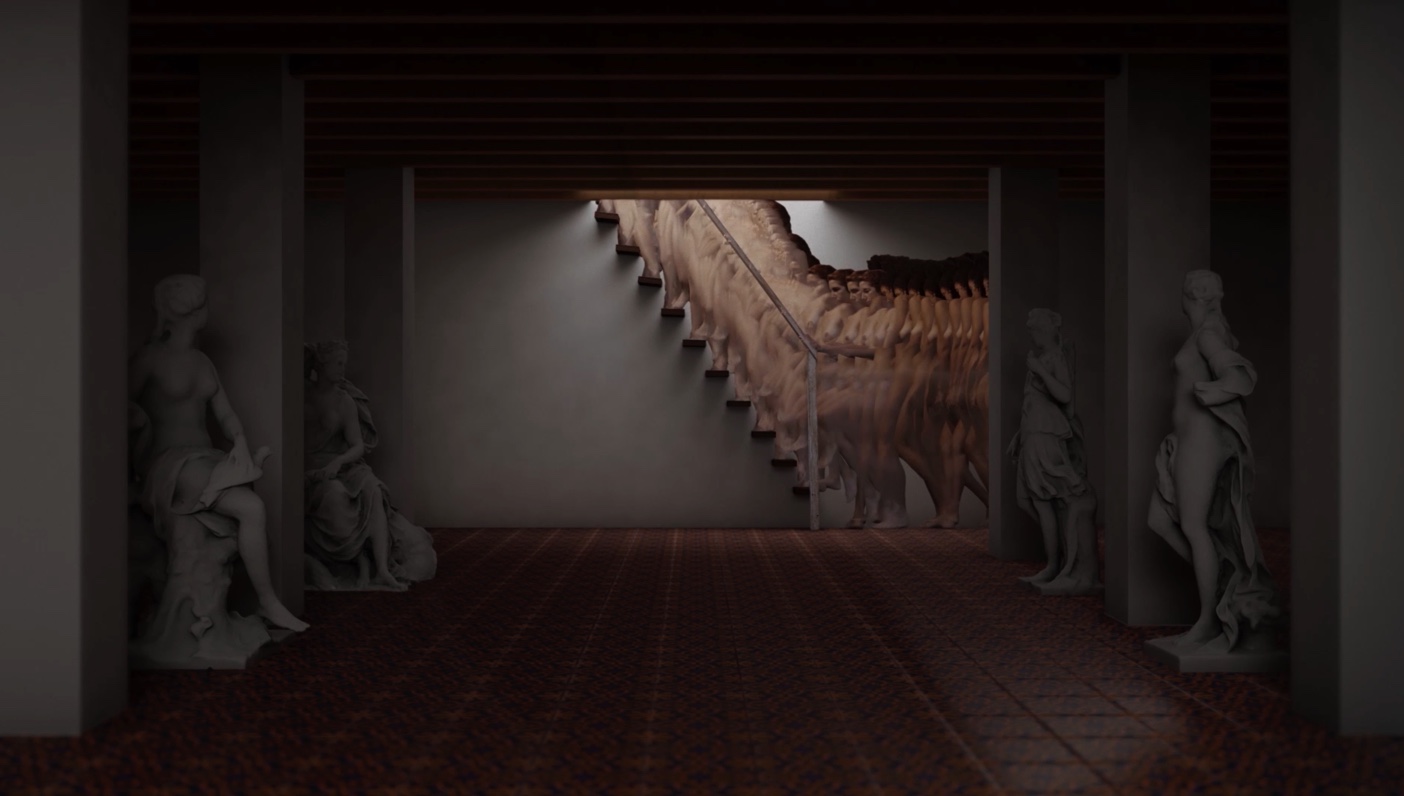
The Limits of Time and Space is a work created in collaboration with architect Daniela Friedman. It challenges the established norms of space and its relationship to the body, especially the bodies of women with disabilities. The piece exists at the intersection of architecture, digital art, and bodily experience, creating an environment where space adapts to the body, rather than the other way around. This work seeks to restore a power dynamic in which women no longer conform to the rules of space—space now bends to them.
The space is organized as an endless hallway, a floor that opens into a tiled abyss, and a staircase that does not impose its form but instead responds to the steps of those who climb it. The structural elements of the environment, typically rigid and dominant, are here malleable, transforming as bodies move within them. Women interact with this architecture, discovering that what was once an obstacle is now refuge and possibility.
This piece explores the subversion of accessibility norms. The unreachable hallway, the floor that gives way, and the staircase that yields to the step are not only metaphors for physical space but also for the social structures that have been designed without accounting for the diversity of the human body. The work is a declaration that space should not exclude, but embrace. Here, women do not have to conform to a world that limits them; instead, the world reshapes itself to meet their needs, shifting the power dynamic between individuals and their surroundings.
The Limits of Time and Space invites the viewer to rethink the relationship between the body and the space it inhabits. The piece emphasizes that norms and physical barriers are not immutable; space can be rewritten, reinvented for those who have historically been excluded. By inverting the gaze and the rules, the work allows us to glimpse a future where accessibility is no longer a constant struggle, but a natural act of inclusion. It questions the role of architecture, design, and social perception, proposing a space where digital art and human experience merge to offer new possibilities of existence.
María Pérez Marín
