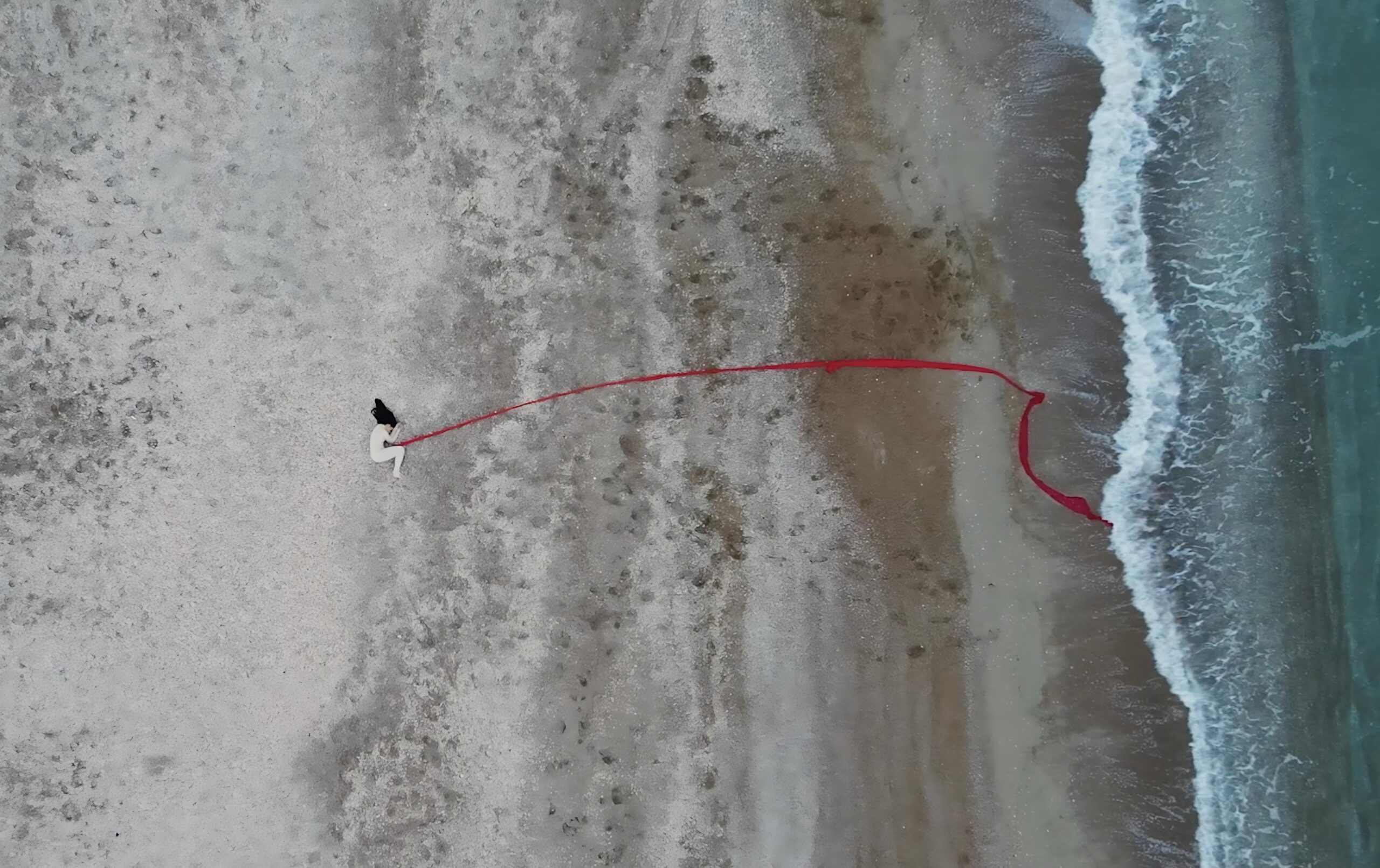
Tel Aviv (Israel), 2023
The tide breathes, expands, and envelops her. Glez remains tethered to the shore by a red umbilical cord—a bond that holds her and names her. It is a thread of blood and memory, a bridge between her body and the sea, between flesh and the infinite. She and the ocean pulse in unison, merging into a rhythm where the waves cradle and claim, reminding us that life is a sacred bond we must honor.
Water floods everything: its sound is the only voice, its movement the only language. The artist lies in a fetal position, her body surrendered to the shore, suspended between origin and release. As the tide rises and recedes, the umbilical cord tightens and yields like a primordial heartbeat connecting daughter to mother, body to immensity.
In the Yoruba cosmovision, the sea is more than a landscape—mother, refuge, and permanence. In “Daughter,” Glez immerses herself in this liquid heritage, evoking the eternal cycle of offering and return. Each wave is both a call and a farewell; each breath is a dialogue between the human and the sacred. In this ebb and flow, femininity and ancestral memory intertwine, reminding us that we are water before we are body and ocean before we are named.
To be a daughter of the sea is understanding existence as a web of invisible bonds. If water creates and sustains us, it also reminds us of our responsibility to other bodies and to other beings. Just as the sea embraces and pulls, nourishes, and transforms, we must recognize ourselves in one another—accept that life is only possible through mutual care. “Daughter” is an ecological hymn to the sea, a reminder that nature is not a distant landscape but a mirror of what we are. In its rhythm, Glez invites us to inhabit interdependence, to hold each other as one cares for water—with reverence, surrender, and the certainty that we disappear without the other.
María Pérez Marín